
AMD Instinct MI300X: The Price-Performance Contender in AI Accelerators
2026-10-19 03:00:00 | pcba-mkr
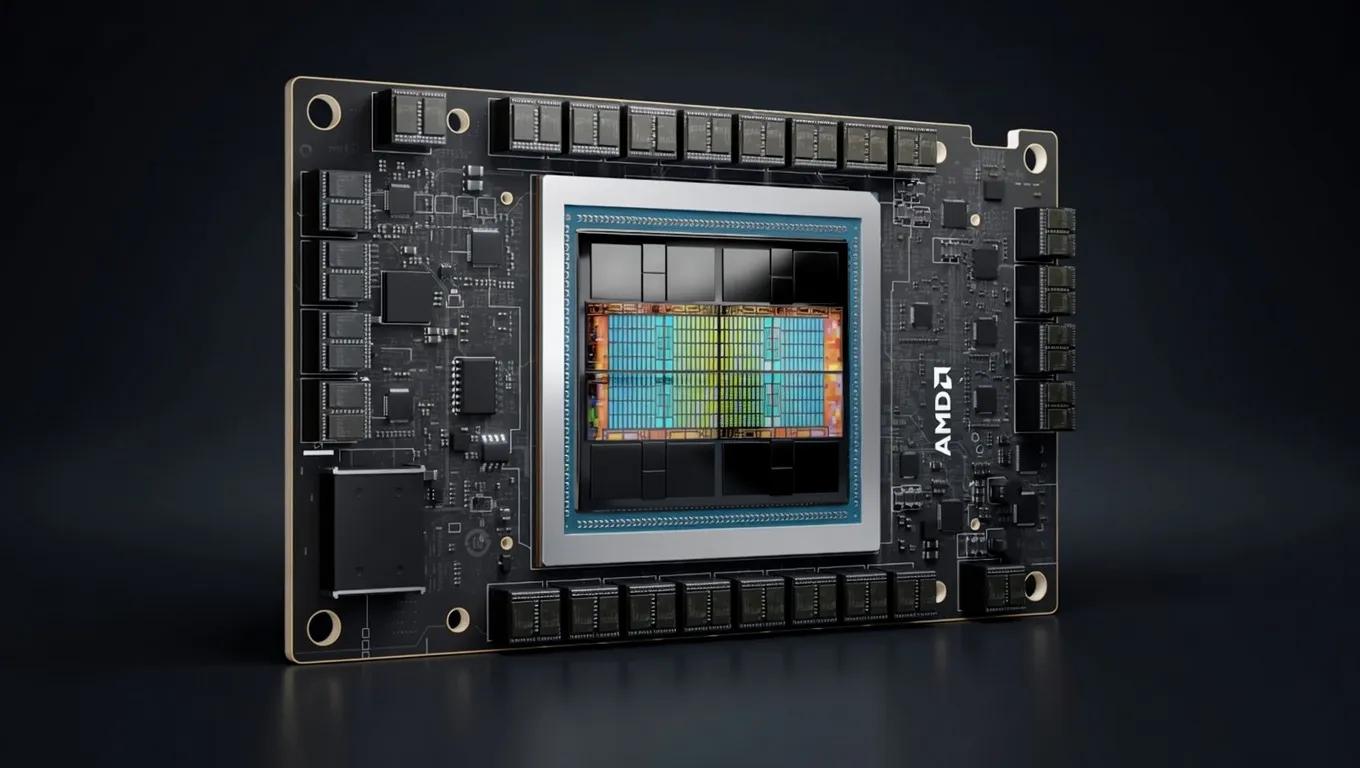
AMD's Instinct MI300X has emerged as the strongest challenger to NVIDIA in the AI accelerator market. Built on the third-generation CDNA architecture and manufactured on TSMC's advanced 5nm and 6nm processes, the MI300X delivers leadership performance for large language model training and inference, at a price point that makes it a favorite for cost-conscious data centers.
Why the MI300X Stands Out
The MI300X features 19,456 stream processors, 1,216 matrix cores, and up to 192GB of HBM3 memory with 5.3TB/s of bandwidth. Its 750W thermal design power and multi-chip module (chiplet) design, built with active interposer dies, let AMD pack massive compute density while keeping memory bandwidth well ahead of competing GPUs.
A Memory Advantage for AI Workloads
One of the MI300X's biggest wins is memory capacity. With 192GB of HBM3, a single MI300X can hold very large models entirely in on-package memory, reducing memory-to-compute transfers and accelerating inference for generative AI. This makes it an ideal accelerator for LLM serving, recommendation systems, and high-performance computing (HPC).
How AMD Competes with NVIDIA
AMD competes on price-performance. The MI300X offers comparable FP16 throughput at a lower cost per chip than leading NVIDIA accelerators, making it attractive for cloud providers and enterprises scaling AI infrastructure. AMD's Infinity Fabric interconnect scales multiple accelerators into large clusters, and ROCm software continues to narrow the gap with NVIDIA's CUDA ecosystem.
Impact on AI Data Center Design
The rise of the MI300X changes AI data center design. Systems built on OCP Accelerator Modules (OAM) use PCIe Gen 5 for scale-up and scale-out, and demand high-performance PCB substrates, dense power delivery, and robust thermal management for 750W accelerators. PCB manufacturers must support high layer counts, high-current copper planes, and controlled impedance to make AMD-based servers reliable.
For Electronics and PCB Manufacturers
As AMD's data center GPU sales grow, the demand for compatible server boards, high-speed interconnects, and precision PCBA assembly rises. Engineers designing for the MI300X need power integrity, signal integrity, and thermal design expertise to build systems that match the accelerator's raw performance.
Conclusion
AMD's Instinct MI300X is a genuine price-performance contender that is reshaping the AI accelerator landscape. For electronics manufacturers and PCB designers, understanding its architecture, power requirements, and ecosystem is key to building the AI servers of the future.
Keywords: AMD MI300X, Instinct GPU, AI accelerator, HBM3, CDNA architecture, data center GPU, ROCm, Infinity Fabric, AI server PCB, OAM module
